
Sactown Scouting Report: The Pace, Poise, and Playmaking of Kingston Flemings
Kingston Flemings has the athletic tools and basketball IQ to make a difference at the NBA level, but is his ceiling high enough for the Kings to consider him at 7th?
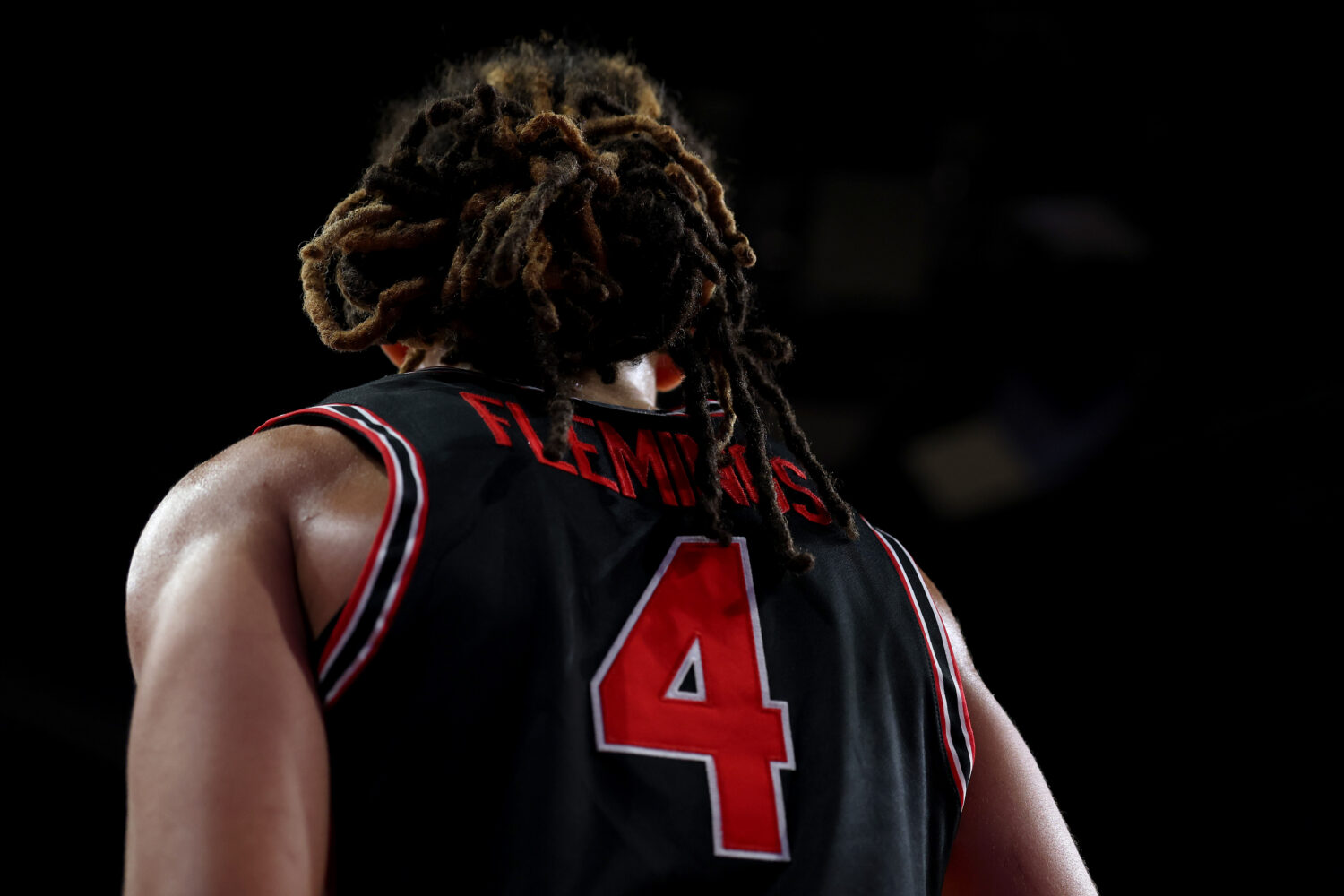
A detailed view of Kingston Flemings #4 of the Houston Cougars jersey during the game against the Arizona State Sun Devils at Fertitta Center on January 18, 2026 in Houston, Texas. (Photo by Kenneth Richmond/Getty Images)
(Photo by Kenneth Richmond/Getty Images)
Given his name, Kingston Flemings feels like a marketing dream prospect to help the Sacramento Kings jumpstart their new timeline. That only works, however, if his game can actually turn heads and prove worthy of the inevitable crown-themed photoshoots.
Full disclosure: my little brother is named Kingston, and we call him King for short, so the name alone already had my attention. I promise that will not factor into the evaluation of the Houston freshman (19 years old) who jumped into the lottery conversation right around where Sacramento’s seventh overall pick lies.
In the first edition of the Sactown Scouting Report, which will feature in-depth 2026 NBA Draft content every Tuesday and Thursday leading up to the draft on June 23rd, let’s dive into the pace, poise, and playmaking that make Kingston Flemings an intriguing talent.
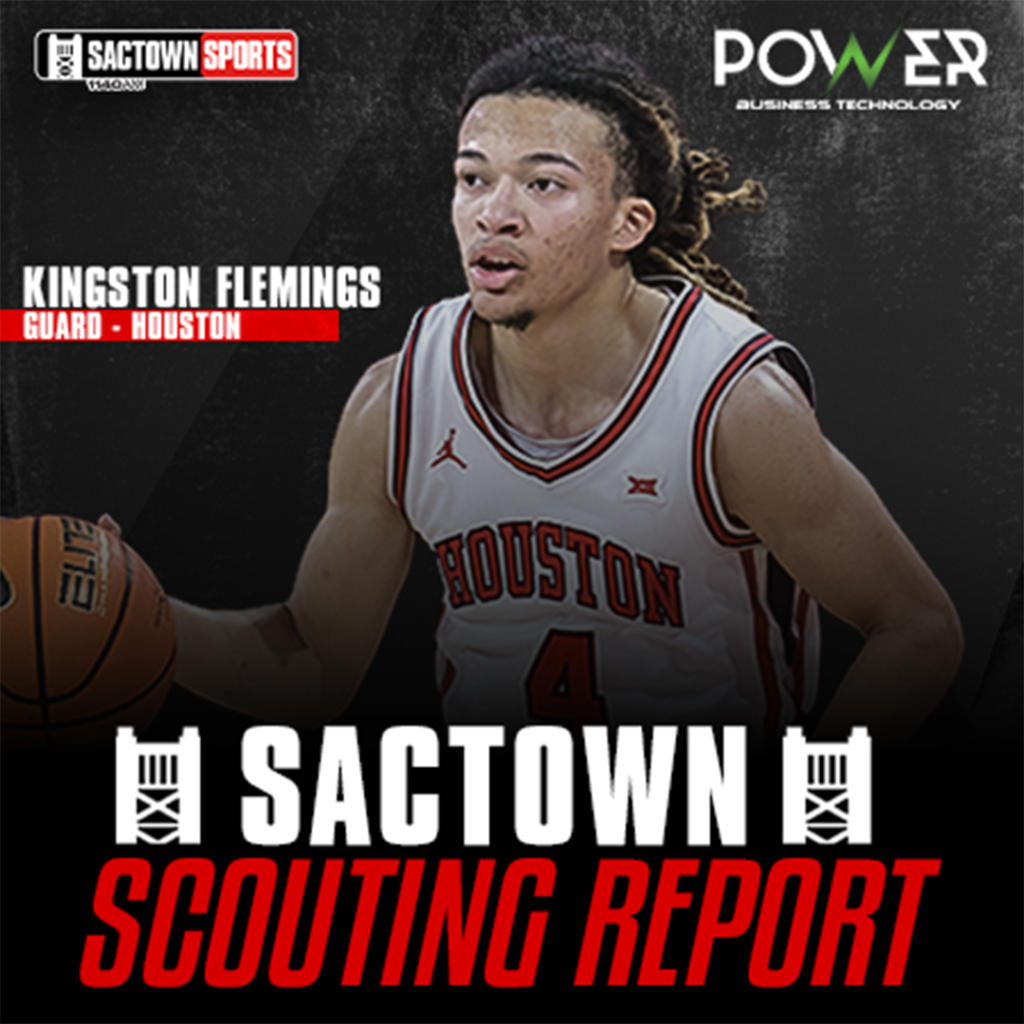
Combine Measurables
-
Height without shoes: 6’2.5″
-
Weight: 183.4 pounds
-
Wingspan: 6’3.5″
-
Standing reach: 8’2.5″
-
Max Vertical: 40.5 inches
Houston had listed Flemings at 6’4″, and — through my computer screen, at least — his wingspan visually appeared longer than it measured at the NBA Draft Combine. Luckily, games are played with shoes on, keeping his in-game height not far off from what his collegiate team listed.
While size is essential, particularly in the modern game, it’s far from the end-all be-all. Stephen Curry, Kyrie Irving, Jalen Brunson, Chris Paul, Kyle Lowry, Trae Young, and Fred VanVleet have wingspans of 6’4″ or shorter. Of course, there are also the likes of D.J. Augustin, Jerryd Bayless, Reed Sheppard, Rob Dillingham, and plenty more in between.
Point being, it’s far from a reason to pass on a player. Athleticism helps mask some of those shortcomings (pun intended), which the San Antonio native possesses with his 40.5-inch vertical, identical to what Donovan Mitchell recorded back in 2017. Yet, it was his speed that jumped off the page more than anything.
In his lone season at Houston, Kingston Flemings averaged 16.1 points, 5.2 assists, and 4.1 rebounds while shooting 47.6% from the field and 38.7% from three.
Superpower: Speed & Shifting Gears
While the 2026 NBA Draft has some ridiculous talents projected to go in the first few spots, a significant reason it’s become so hyped up is the number of players that would likely be top five in any other class. There are different styles of players in that group, including a slew of point guards, each with a primary strength, or what I’ll refer to as their superpower.
For Kingston Flemings, it’s his lightning-quick burst that could explain why his favorite player growing up was Derrick Rose, and De’Aaron Fox is one of the players he’s studied. As Sacramento fans will remember, Fox would go from zero to one-hundred more often than not early in his career before weaponizing it by shifting gears, creating more opportunities to catch defenders off guard.
The freshman guard already displayed an exceptional understanding of that at just 19. The clip below features a wide variety of scenarios, but adjusting speeds is a fundamental part of his playstyle that helps unlock everything else.
Speed is one of Kingston Flemings superpowers, and he uses that to his advantage.
Great at manipulating defenses by shifting gears and clearly understands coverages well.
Said his favorite player was D. Rose + studied Fox, and you can see it. (More film on him coming today) pic.twitter.com/v64LEPPlt1
— Brenden Nunes (@BrendenNunesNBA) May 13, 2026
I was almost left wondering what his true top-end pace looks like, but unexpectedly turning on the burners and gliding past defenders when needed unlocked everything else. Even the threat of that lightning launch first step was enough to unlock other scoring avenues.
Rim Pressure vs. Efficiency
One of the main benefits of Flemings’ superpower is how easily it allows him to generate paint touches. How many times have you heard head coaches talk about the importance of that?
Part of the reason he became the focal point of an offense with other, more experienced guards was his ability to bend defenses by reliably pressuring the rim. The first clips showed his ability a couple of times, with the initial dunk being the most obvious.
Per Bart Torvik, 35% of his total field-goal attempts came around the rim, an exceptionally high rate. But getting there is only half the battle, and his finishing ability fluctuated at times, converting 57.2% (95/166) at the basket.
That combination makes finishing one of his clearest areas for improvement if he is going to become an All-Star-caliber guard in the NBA. The physical tools make some optimistic about his potential in that area, and his current baseline is certainly encouraging, just not as elite as Darius Acuff Jr.’s 59.7% or Mikel Brown Jr.’s 65.3%. Fox (64.5%) and Maxey (65.1%) were top-tier around the rim in college.
Flemings’ finishing mark is closer to Keaton Wagler’s 57.5%. Keep in mind, I wanted to be sure to include both impressive finishes and shortcomings in the clips below.
While not an elite college finisher, Flemings showed some good touch around the basket.
Improving his strength, and as he’s highlighted embracing playing thru the second bump, could go a long way here.
Note how easy he gets there and the baseline to continue improving. pic.twitter.com/xBPMtkn0xE
— Brenden Nunes (@BrendenNunesNBA) May 14, 2026
Rarely “doing too much” with the ball, he typically would make one quick move (hesitation, stepback, behind-the-back) and showed varying levels of ball-handling ability, while still being plenty capable. Keep that in mind when watching his plays.
His slender frame and inconsistent willingness to embrace contact factor into that, but Flemings himself has acknowledged this as a needed next step, saying he’s working on widening his base and embracing the second bump more often. He also showed a real lack of floaters, which will be important to develop at the next level.
That may also help explain why a guard with his downhill mindset attempted just 3.5 free throws per game. He also wasn’t playing in a well-spaced, NBA-style offense with only two of his Cougar teammates attempting more triples in Emauel Sharp (37.2% on 7.1/g) and Milos Uzan (34.3% on 5.7/g).
Perhaps being the best on his Houston team at generating paint touches made him more focused on setting up others rather than attempting tough finishes, but it’s probably not a coincidence that his highest scoring output (42 points, setting the school’s single-game record for a freshman) came with 10 attempts from the line.
Being aggressive in finding his own shots, just as much as for others, seemed to be the difference.
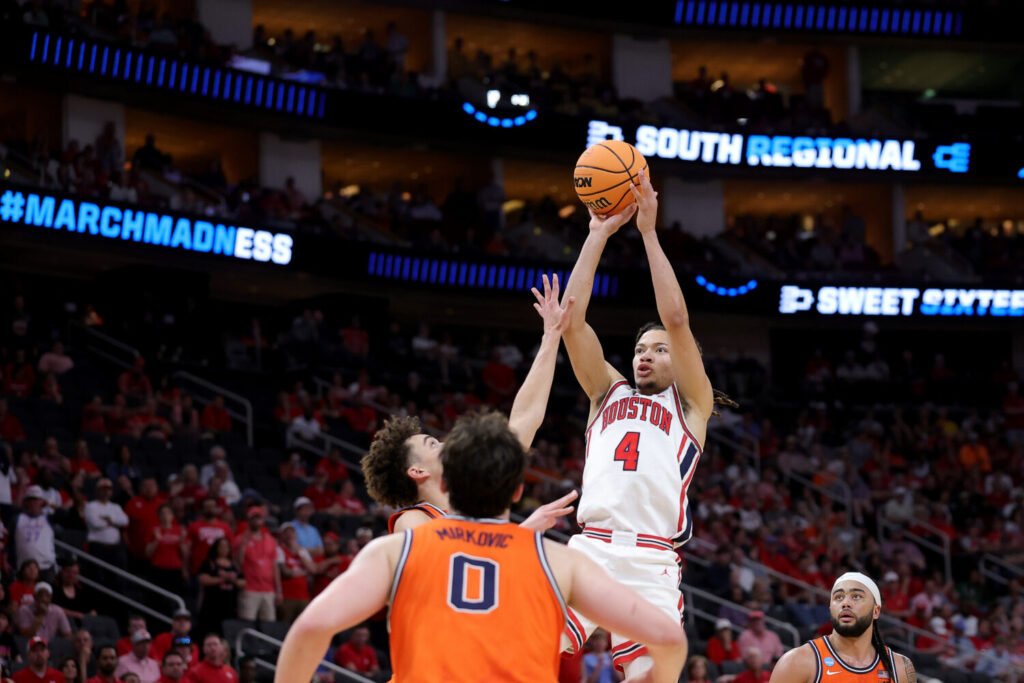
Kingston Flemings #4 of the Houston Cougars shoots against the Illinois Fighting Illini during the Sweet Sixteen of the 2026 NCAA Men’s Basketball Tournament at Toyota Center. (Photo by Alex Slitz/Getty Images)
Shooting Projection
Being able to stop on a dime and pull up is practically a cheat code when you’re as fast as Kingston Flemings — once again, think of Fox, Maxey, John Wall, Chris Paul — and the guard lived in the mid-range.
He shot 44 percent on mid-range attempts, per Bart Torvik, an impressive number for a smaller guard. Dybantsa, who most expect to go first overall, measured in at 6’8″ at the combine, shot 46.3% on those chances.
If you had to pick a go-to shot for Flemings, this would be it.
keeping that change of pace + top end accell in mind, Flemings loved the mid-range game.
Relied on it more than some may like, but could get to it pretty much whenever he wanted pic.twitter.com/RxWck3RRiu
— Brenden Nunes (@BrendenNunesNBA) May 14, 2026
And, yes, that shot still has its place in the NBA as long as it’s being knocked down at an efficient enough rate — even if last year’s Sacramento squad, I’d argue, went a bit overboard there. Flemings did shoot 38.7 percent from beyond the arc, but NBA teams will likely have questions about the volume, given he took just 2.9 per game (41/106).
His 46% mark on catch-and-shoot opportunities breeds confidence in his ability to space for others, but most star guards in the league can also create those looks on their own. The freshman was able to do that, just not frequently. Interestingly, it felt like they were much more common late in close games. Note the time and score of the clips below.
He didn’t shoot a high volume of 3P (2.9/g), but converted 38.7%.
It seemed like they appeared more in late, close games and did create *some* good looks for himself.
84.5 FT% bodes well for his projection here too pic.twitter.com/yB5ZjDpbwF
— Brenden Nunes (@BrendenNunesNBA) May 14, 2026
His form is a bit funky, but I’m of the opinion that if it goes in, it all counts the same. Shoutout to Tyrese Haliburton. The lower volume leaves some questions, but the catch-and-shoot, free-throw, and mid-range comfort are multiple positive indicators.
A “Traditional” Point Guard
Kings head coach Doug Christie and general manager Scott Perry have talked about the importance of having a “traditional” point guard on the floor. They need someone who can run the show and empower his teammates. Kingston Flemings fits that mold and even said he takes pride in making life easier for those around him.
“You can put me into any team, and I’m gonna make the teammates around me better,” he said in an interview at the combine. “I’m gonna learn my teammates.”
In my mind, this is one of his greatest skills and where his basketball IQ is potentially most apparent. Flemings routinely orchestrated his teammates on the offensive end, asking bigs to flip screens, recognizing zone defenses, and taking advantage of seeing the same coverages multiple possessions in a row.
He is not necessarily a master manipulator of the pick-and-roll; it was usually him, once again, using his downhill threat to create opportunities. You can see him read not only the first help defender, but also often the second level, and make his decisions quickly from there.
And his passing may be what impressed me most. pic.twitter.com/GowAG51ivt
— Brenden Nunes (@BrendenNunesNBA) May 14, 2026
Slinging dimes off a live dribble with one hand is impressive stuff. Doing so while managing an absurd 2.8 assist-to-turnover ratio (5.2 assists to 1.8 turnovers) is the cherry on top.
That table-setting profile could be especially appealing to someone like the Mavericks, who have other play-finishers on their team, but the Kings obviously lacked someone who could orchestrate their offense on a consistent basis, which is why Russell Westbrook helped.
We’ll get more into his fit with Sacramento later, but it’s no secret how much their coaching staff and front office value the defensive end of the floor, too.
Defensive Playmaker Off-Ball
Kingston Flemings recorded six games with three or more steals, including an eight-steal performance against Florida State. In a phenomenal film breakdown interview with Ben Pfeifer, he said his Houston coaches tracked 13 deflections, which either tied or broke the school’s single-game record (which is not a public stat, for what it’s worth).
It is another area where you can see that he is a student of the game, studying opponent tendencies and capitalizing on them.
Christie often emphasized the importance of the Kings’ “shell” defense, proper rotation, and appropriate help based on where they’re positioned on the floor. The “low man” (whoever is guarding the weakside corner, a.k.a., the defender farthest away from the ball) has the most important role of them all, as they can provide the most help defensively while still having a chance to recover.
That’s where a lot of smaller guards struggle — Malik Monk is a good example for Kings fans to think of. Sorry, Malik.
It’s an area where Flemings can still make an impact. The second clip included below, denying a lengthy forward’s drive as the low man, is a prime example.
his on-ball D was somewhat tough to evaluate given Houston’s aggressive defense, but that also left him in plenty of scenarios where he had to help.
That’s where his active hands and high IQ shone thru pic.twitter.com/XAre4jUjaO
— Brenden Nunes (@BrendenNunesNBA) May 14, 2026
Here’s another example that displays his understanding of where he’s supposed to be as the ball moves from side to side. Although it may appear simple, it’s the type of thing I’d bet Coach Christie loves to see from a prospect.
I think these types of plays are why Kingston Flemings is going to be at least a neutral defender – they aren’t loud, but they don’t really require the 6’7″ wingspan other guards in this class have.
Keeps the handoff in front of him, switches without confusion, follows the… pic.twitter.com/Sb6Okv3ksN
— Logan Adams (@LoganPAdams) May 12, 2026
He was not immune to losing track of his assignment while monitoring the ball, but it was nowhere near as frequent as it was with others.
On-ball, his size and frame could be weaknesses. I’d argue that his active hands could allow him to hold his own in this area, but that NBA teams will test that all throughout his rookie campaign.
Houston’s aggressive scheme left few scenarios in which Flemings was truly asked to guard one-on-one, and it’s another reason why increasing his strength will be important.
The Case At No. 7
Having exceptional burst and acceleration, along with the basketball IQ, hustle, and athleticism to go with it, makes me believe the Houston product has a higher floor than some of the other guards that could be considered for Sacramento should they remain at seventh overall.
But a higher floor does not automatically mean the ceiling is limited. Some draft analysts believe he fits that mold. I (and they) have certainly been wrong before and will be again, but this is a 19-year-old who most expected to spend at least two seasons in college before he outperformed that expectation.
Improving his strength and physicality feels like a must. Becoming a better finisher at the rim could come alongside that, but his handle will need to grow tighter as well if he’s ever going to regularly contend for All-Star status.
The swing question is whether the rim finishing, strength, and pull-up three volume grow enough for him to be more than a high-level organizer.
I buy the three-point shooting, but recognize that the lower volume leaves less evidence to support it. I understand the case for Sacramento needing more upside at this early point in their rebuild, retool, or whatever label best applies to their roster construction plan.
Finding their franchise-altering talent will be the most important piece to the puzzle, but every Cooper Flagg still needs players like Kingston Flemings alongside him, too. And if the swing skills hit, who’s to say “King” can’t grow into a stellar 1B-type player himself?
More Sacramento Kings content from Sactown Sports
- Post-Lottery Mock Draft Has Kingston Flemings Going To Sacramento
- The Sacramento Kings nearly got the 3rd pick in the 2026 NBA Draft Lottery
- Did the Kings hurt their rebuild by chasing wins?
- First Look: Sacramento Kings New Jersey Patch Sponsorship Beginning in 2026-27
Upcoming Sacramento Kings & NBA Offseason Schedule
- Tuesday, June 23rd – NBA Draft (Round 1)
- Wednesday, June 24th – NBA Draft (Round 2)
- Tuesday, June 30th – NBA Free Agency negotiation period begins (3 PM PT)
- Thursday, July 9th – NBA Las Vegas Summer League begins
- Monday, July 13th – Free Agency moratorium ends / signings can become official
Thank you for reading SactownSports.com. Follow us on Twitter and Google News, and subscribe to our YouTube channel.
Related
 Raynaud exits early in Kings preseason loss to Warriors
 Brock Purdy embraces hostile Seattle environment ahead of 49ers-Seahawks
 Kings kept it close, but fell to Lakers again in preseason
 Has Scott Perry’s next free agent target been revealed?
 Kyle Shanahan praises Deebo Samuel ahead of 49ers-Seahawks showdown
 Sando: 49ers’ sack-free start shows Brock Purdy’s growth

Comments
0 Comments