
Why Sacramento State Is Paying a Record Price to Move to the FBS
Yahoo! Sports' Ross Dellenger joined Jason Ross to share his thoughts on why Sacramento State football made its aggressive bid to join the FBS.

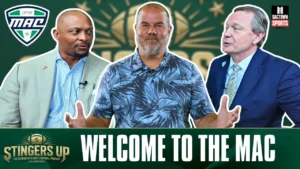
Watch: Ross Dellenger Thinks Sacramento State Should Be Able To 'Make Some Noise' In The MAC | 13 mins
Sacramento State is officially making the jump from the FCS to the FBS, joining the Mid-American Conference in a move that highlights the changing landscape of college football.
In an era defined by realignment, buy-in fees, and constant movement, the Hornets’ decision is about more than one program moving up a level.
It’s another data point in a sport where ambition increasingly comes with a significant financial commitment — and Sacramento State’s path has drawn national attention.
Sactown Sports’ Jason Ross spoke with Yahoo! Sports’ national college football writer Ross Dellenger, where the conversation quickly shifted from a local storyline to a broader examination of where college football is headed.
𝙄𝙏’𝙎 𝘼 𝙉𝙀𝙒 𝙀𝙍𝘼 𝙄𝙉 𝙃𝙊𝙍𝙉𝙀𝙏 𝙁𝙊𝙊𝙏𝘽𝘼𝙇𝙇
Sacramento State set to join the MAC in 2026. #StingersUp #MACtion https://t.co/iA1gM8bNfm pic.twitter.com/VlcUUcW24u— Sac State Football (@SacHornetsFB) February 16, 2026
“It was probably the most costly move that we’ve seen in college football history,” he said.
Sacramento State’s entry into the Mid-American Conference comes with an $18 million price tag — $6 million paid up front to join immediately, followed by $3 million per year over the next four years. The size of that number alone put the Hornets’ transition on the national radar.
But as Dellenger explained, this wasn’t a sudden or impulsive decision. Sacramento State had been pursuing FBS options for some time, including a waiver attempt that was denied last summer. After that, the focus shifted to finding a realistic path forward.
“They had been working really hard to get FBS,” Dellenger said. “After the waiver was denied, I think they started to amass a plan to sort of buy their way into some league.”
What’s next for Sacramento State football?
Geographically, the Pac-12 or Mountain West would have made more sense. When those doors didn’t open, the MAC emerged as a viable alternative — not as a final destination, but as a starting point.
“This doesn’t feel like the end game,” Dellenger said. “It’s a short-term deal where you can elevate yourself, prove that you belong, and maybe move on from there.”
One of the central questions surrounding the move is whether the financial investment can be justified. Sacramento State commissioned consultants to study the potential impact, with estimates suggesting roughly $250 million per year in economic impact — a figure that raised skepticism.
“Seems high,” Dellenger admitted. “I don’t know how they get those numbers.”
Still, he pointed to historical trends showing tangible benefits when schools move from FCS to FBS, particularly in enrollment growth and overall visibility.
“There is just more exposure,” he said. “You’re going to be on ESPN, you’re eligible for bowls and, eventually, the College Football Playoff. That visibility matters.”
On the field, Dellenger believes Sacramento State may be better positioned than many realize. Based on roster spending, NIL, and revenue-sharing commitments, he expects the Hornets to be competitive quickly.
“I would think they’d be in the top half, if not the top third, of the MAC,” he said.
Dellenger’s assessment is rooted in resources and geography. Many MAC programs operate closer to high-level FCS budgets than power-conference standards, and Sacramento State’s location could provide advantages few conference peers can match.
“Nobody else in the MAC can offer that recruiting hotbed, the weather, the livability of that area,” Dellenger said. “They’ve got an advantage there.”
The costs don’t stop with the entry fee. Sacramento State also agreed to cover air travel expenses for other MAC schools — an unusual arrangement within an FBS conference. Dellinger estimated those costs could total between $2.5 and $4 million over five years.
“That’s extraordinarily unusual in FBS,” he said.
Even so, those numbers may pale in comparison to what’s coming next across the sport. Dellenger expects another wave of realignment tied to expiring TV deals and playoff contracts between 2029 and 2032, likely accompanied by even larger entry fees at the power-conference level.
“We probably will see a lot more realignment,” he said, including “multi-million dollar entry fees” for schools trying to elevate further. Viewed through that lens, Sacramento State isn’t operating outside the norm — it’s operating early.
“This is the path we’ve seen,” Dellinger said. “It’s the cost of doing business now.”
Be sure to check out the entire interview with Yahoo! Sports’ Ross Dellenger at the top of this page, or on the Sactown Sports 1140 YouTube channel.
Listen to The Carmichael Dave Show with Jason Ross from 6 – 10 a.m. PST, Monday through Friday, on Sactown Sports 1140.
Click here for full episodes of The Carmichael Dave Show with Jason Ross.
Thank you for reading sactownsports.com. Follow us on Twitter and Google News, and subscribe to our YouTube channel.
Related
 Sac State Football ready to ‘flush’ loss ahead of home opener
 Sacramento State Football enters FBS era with ‘Prove It’ mentality
 “We’re Here to Win the MAC”: Alonzo Carter’s Vision for Sacramento State Football
 The Zo Era Begins: Alonzo Carter Lays Out His Vision for Sac State Football
 Sacramento State Football gets high praise at MAC Media Day
 Welcome to the FBS: Sacramento State releases 2026 schedule

Comments
0 Comments