
Sactown Scouting Report: The Star-Swing Case for Darius Acuff Jr.
Darius Acuff Jr. offers one of the best star-swing bets in the 2026 NBA Draft, but his defensive concerns and tough-shot diet make the projection far from simple.

Darius Acuff Jr. #5 of the Arkansas Razorbacks looks on during the first half against the Ole Miss Rebels in the semifinal game of the 2026 SEC Men's Basketball Tournament at Bridgestone Arena on March 14, 2026 in Nashville, Tennessee. (Photo by Johnnie Izquierdo/Getty Images)
(Photo by Johnnie Izquierdo/Getty Images)
Darius Acuff Jr. was one of the most electric players in college basketball last season. Functioning as the offensive hub for an Arkansas team that made it to the Sweet Sixteen, the dynamic scorer turned heads and climbed draft boards as the year went along.
There was no higher praise than longtime collegiate head coach Sean Miller saying he’s “never seen a player better” than Acuff in his 34 years around the game. “Guys like him, they just don’t come into college basketball very often. He’s a generational player.”
Miller even went as far as saying Acuff should be more strongly considered for the first overall pick in the 2026 NBA Draft. This came after the 19-year-old led the Razorbacks to a 20-point victory over the Longhorns with 28 points and 13 assists.
With the Sacramento Kings landing the seventh overall pick in the Draft Lottery, their hopes of landing a true No. 1 option had taken a major hit, but not disappeared. Perhaps the Clippers or Nets will swoop in before Sacramento is on the clock, but if Miller’s evaluation is right, he could drastically change a team’s trajectory.
So, why isn’t he projected to go in the top three?
Continuing the Sactown Scouting Report series, let’s break down what made Darius Acuff an elite offensive engine and the questions that are likely knocking his expected draft position.

Combine Measurables
- Height without shoes: 6’2″
- Weight: 185.8 pounds
- Wingspan: 6’6.5″
- Standing reach: 8’2.5″
- Max Vertical: 36.5 inches
The measurables are not where Acuff stands out, as his shorter stature doesn’t add to his appeal, but plenty of top-tier players at that height have carved out Hall of Fame careers. His 6’6.6″ wingspan came in as a notable plus, while a 36.5-inch vertical didn’t jump off the page — pun intended.
NBA players of a similar size include Damian Lillard, Tyrese Maxey, Collin Sexton, Devin Carter, Bronny James, and Jalen Brunson. But his vertical lies a bit short of Lillard’s 39.5-inch max, instead matching what Derrick White and Coby White recorded while just short of Jalen Brunson (37 inches).
Athletic and physical profiles matter at the NBA level, but how those tools show up on the court matters more.
Superpower: Self-Creation
Advantage creation is one of the most valuable skill sets an NBA player can bring to their team. Being able to do so consistently is what separates All-Stars from sixth men, and Darius Acuff was one of the best players in college basketball at bending defenses.
In his lone season at Arkansas, the true freshman averaged 23.5 points on 48.4% shooting and converted 44% of his 5.8 three-point attempts per game. Pick-and-roll accounted for the majority of his possessions, but even without a screen, he found success within isolation.
While not as fast as someone like Kingston Flemings, Acuff still possesses a good enough first step, change of pace, and handle to routinely get by his defenders. Being a true threat from all three levels on the floor added to that ability, with defenders having to respect his ability to stop and score at any point during the possession.
People can say the mid-range is dying all they want, but it still has clear value in the league and was something Acuff relied heavily on. He shot 40.1% on eight mid-range attempts per game.
Acuff is also a strong mid range scorer who excelled at getting to his spots off the PNR or as an isolation creator.
Acuff also had a strong floater and shot a combined 42% from the mid range and floaters in the PNR and in isolation.
Acuff’s ability to effectively score in… pic.twitter.com/cOpkfjtKUi
— KJ (@KJScouting) May 13, 2026
While his reliance on that shot has raised concerns about his shot profile, it’s a useful tool in his extensive bag. What intrigued me most was his comfort level with floaters: some came off the same foot, others were released before opponents expected, and they mixed beautifully with his passing. We’ll get to that in a bit.
As for his finishing, Acuff converted 59% of his looks at the rim, per Bart Torvik. That’s not a stellar mark, with top-tier finishers like De’Aaron Fox (64%) and Jaden Ivey (67%) being notably better at the collegiate level.
A more optimistic comparison would be Ja Morant’s 60% rate at the rim with Murray State, but his athleticism was obviously on a different level than Acuff’s. Still, with over 200 attempts as an under-the-rim 6’2 guard, 59% was solid.
Appearing comfortable with either hand, he was more of a finesse finisher rather than looking to play through contact. That play style helped produce a 37% free-throw rate, with Acuff scoring 178 points at the line.
Between his handle, midrange pull-up game, floater touch, and slithery finishing, Acuff had one of the most complete scoring packages in college basketball. My concern would be more focused on the vast differences that come with playing at the next level.
Being a tough shotmaker is valuable, but creating good looks is always preferred, and the Arkansas product did more of the former. I’m not saying that will hinder his effectiveness at the next level, but it factors into the range of his potential outcomes.
Shooting: Pull-Up Gravity and Off-Ball Value
To call Darius Acuff an elite distance shooter last season somehow feels like an understatement. He made 44% on 5.8 three-point attempts per game and created plenty off the bounce.
But that skill set also enabled his off-ball gravity, with his 49% on catch-and-shoot threes serving as a prime example. Left unguarded, that rate increased to an absurd 60%. When left open from deep, it felt like a guaranteed three points on the board.
Darius Acuff shot 50% on 120 catch and shoot attempts
Elite 3 point shooter, has the ability to play off the ball if needed pic.twitter.com/rr9sDrujBP
— NetsKingdom 👑🗽 (@NetsKingdomAJ) May 16, 2026
Give him an opportunity to attack a closeout from there, getting to play with an advantage rather than having to create it himself, and that should work out well. Perhaps one of the more underrated aspects of his game, Acuff may be better at playing off the ball and alongside other creators than people give him credit for.
The Kings should not draft based on their current roster, but it is easy to imagine how dangerous Acuff could be passing and chasing into a dribble handoff from Domantas Sabonis.
Being able to knock down self-created triples is where the star potential shines, but his elite shooting off-ball bodes well for playing alongside other creators.
Passing: A True Offensive Hub
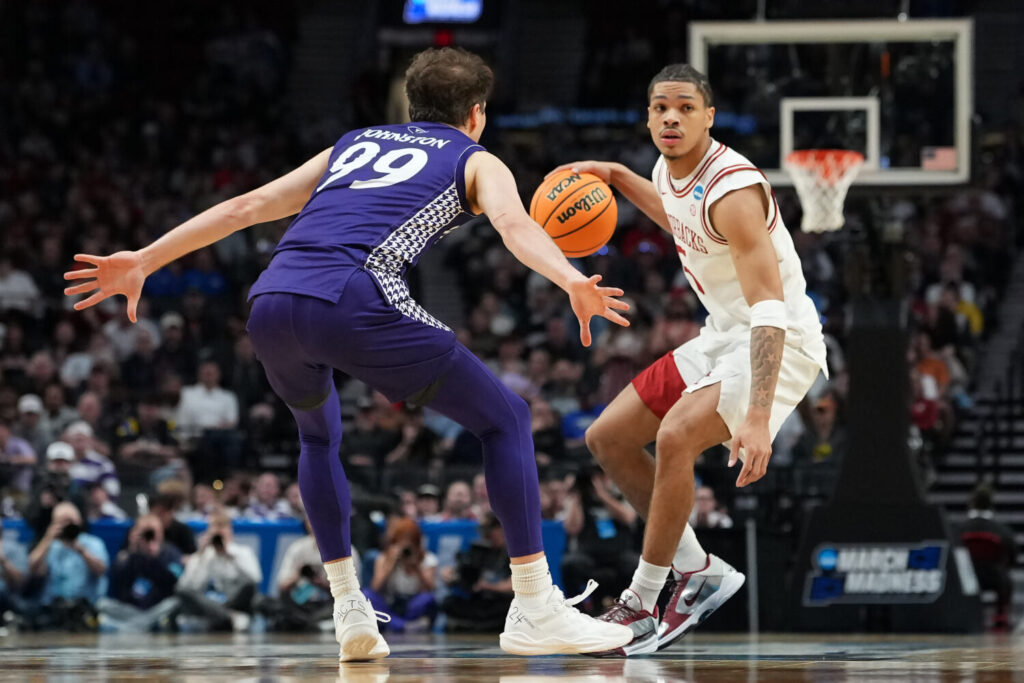
All of the advantage creation moments are fantastic, but the comfort Acuff displayed in finding the open man after the fact was what made him a true offensive engine in John Calipari’s offense. His 6.4 assists per game led to a 32.2 assist percentage, meaning he assisted on nearly a third of Arkansas’ made baskets by teammates while he was on the floor.
Being able to read the low man and swing it to the weak side off of a live dribble with either hand was impressive, as were the reads he made in the pick-and-roll of all varieties. But perhaps one of the more specific but notable skills that Acuff displayed was his touch on lobs.
This is where his floater game comes back into play. Trae Young is one of the best current examples of this, where you could pause a clip right before the ball leaves his hands, and you can rarely differentiate if he’s about to throw a lob or attempt a floater, and Acuff possesses a similar trait.
5.1:1 ast:tov ratio for Darius Acuff over his last 5 gms.
Arguably the best OFF engine in the 2026 NBA Draft—Acuff has used his dynamic handle, pacing, & speed to carve up DEFs. The best lob thrower in college hoops. Constant paint touch threat who makes every read in the book. pic.twitter.com/zfT1INaJO9
— NBA Draft Dude 🤙 (@CoreyTulaba) December 17, 2025
Despite doing it all for the Razorbacks offense, he also hardly turned the ball over with an impressive 11.6% turnover rate. He had three games with at least 10 assists and zero turnovers, and 11 games total with one turnover or less. Taking care of the ball while carrying that level of offensive burden and consistently setting up teammates is why he has true offensive-engine upside at the next level.
(Photo by Soobum Im/Getty Images)
Can the Creation Scale?
Being able to reliably force rotations at the next level could be the swing skill. Not having standout athletic tools, paired with a handle that is good but not yet elite, raises questions about how it could translate against the wide array of talented, lengthy on-ball defenders who check the best opposing players.
Going against the likes of Lu Dort, Jaden McDaniels, and Dyson Daniels will be a different beast than anything Darius Acuff faced in the SEC. Will he be able to reliably get past his defenders when needed, allowing his isolation game to translate?
Being a slippery finisher has its place, but playing through contact is a necessary skill as well. Kyrie Irving’s elite footwork allows him to slide around defenders, but you still see him jump into bigs to create space when needed. Jalen Brunson, who feels like a reasonable comparison for Acuff, is a similar story.
To put it bluntly, Acuff’s entire appeal lies in that superpower of creating advantages, and the difficulty of doing so rises tremendously at the next level. That could be the difference between Acuff approaching the Lillard/Brunson-style high-end outcome and settling closer to a Sexton-type scoring guard role.
Defense: The Biggest Question
Darius Acuff was an atrocious defender at the college level, with numerous possessions in which he showed a clear lack of effort. There may be some necessary workload context here. Recent Kings rookie Maxime Raynaud has said Kyle Smith instructed him to avoid foul trouble at Stanford because of how essential he was offensively, and it is fair to wonder whether Arkansas gave Acuff a similar level of offensive protection.
Perhaps it was a similar story for Acuff, or it was understandable that consistently providing immense effort on both ends was too much to ask. Either way, the lowlights are about as bad as it gets, and being a shorter player certainly didn’t help his cause either.
I heard that Darius Acuff Jr. might be the worst defender in the NBA next year. Watched his defense during the SEC Championship to see if people were exaggerating.
It’s pretty rough. pic.twitter.com/GbLRN9nH13
— Steph Noh (@StephNoh) March 19, 2026
Darius Acuff is basically undeniable as an offensive prospect…
Worldclass live-dribble creativity, pass accuracy, & scoring efficiency + volume. Legit floor general. The defense end has some VERY suspect metrics attached to it. Intriguing prospect. pic.twitter.com/fYC8siriT7 https://t.co/cFX1blDjKL
— Basketball University (@UofBasketball) April 2, 2026
That’s going to be the first thing that opposing teams test him on. I’d expect him to be constantly targeted early in his career, needing to prove he’s got more than he showed with the Razorbacks. Boasting a solid, somewhat stocky frame leaves potential for him to hold his own against larger players.
Asked about his defense at the combine, Acuff said, “I know I want to play defense… I do feel like I need to pick up my defense. So I’m gonna do it.” The film was not without encouraging moments, but they were too infrequent to erase the larger concern.
Will sharing the floor with other NBA-caliber creators allow him to put more effort into the defensive end? If not, can his offensive production truly outweigh the downsides?
Kings Fit: Risking It For The Upside
Sacramento general manager Scott Perry is likely more familiar with Darius Acuff Jr. than most people, as he coached Darius Acuff Sr. at Eastern Kentucky in the 1998-99 season. They’re also both from Detroit, Michigan.
With the seventh overall pick, most people seem to believe that Acuff Jr. will already be off the board by then, but with other talents like Keaton Wagler, Kingston Flemings, Mikel Brown Jr., and Brayden Burries in the class, who knows how it will shape out.
The Kings need a star-level swing more than anything, but missing on a top-seven pick would be a major setback for a franchise that cannot afford another stalled timeline. In my mind, that’s exactly the risk that would come with taking Acuff.
I can’t help but wonder what he would look like if he doesn’t reach his ceiling of a true offensive engine in the NBA. As mentioned, the caliber of defenders improves dramatically, and a below-the-rim, tough-shot-making style of play feels very hit-or-miss. Not to mention his defensive questions, where becoming even passable would feel like a win.
That is the tension with Acuff: the upside is obvious, but the floor is more concerning than some of the other guards in his range. I’d argue that Flemings has a much higher floor while still possessing the potential to be an All-Star talent.
Perry will have a difficult decision to make on June 23, but Acuff and this guard class are creating the right kind of problem for Sacramento. Several intriguing swings should still be available when the Kings are on the clock.
More Sactown Scouting Reports
Sactown Scouting Report: The Pace, Poise, and Playmaking of Kingston Flemings
Upcoming Sacramento Kings & NBA Offseason Schedule
- Tuesday, June 23rd – NBA Draft (Round 1)
- Wednesday, June 24th – NBA Draft (Round 2)
- Tuesday, June 30th – NBA Free Agency negotiation period begins (3 PM PT)
- Thursday, July 9th – NBA Las Vegas Summer League begins
- Monday, July 13th – Free Agency moratorium ends / signings can become official
Thank you for reading SactownSports.com. Follow us on Twitter and Google News, and subscribe to our YouTube channel.
Related
 Big nights from Sabonis & Acuff aren’t enough as Kings fall to Blazers
 49ers’ Brock Purdy works to build chemistry with changing receiver group
 49ers need WRs to step up if Mike Evans misses Falcons game
 Kings’ Shot Selection Problems On Display in Season Opener
 High School Showcase: Del Oro HC Josh Parry
 Sam Amick on Doug Christie’s job security & Zach LaVine’s trade value

Comments
0 Comments